

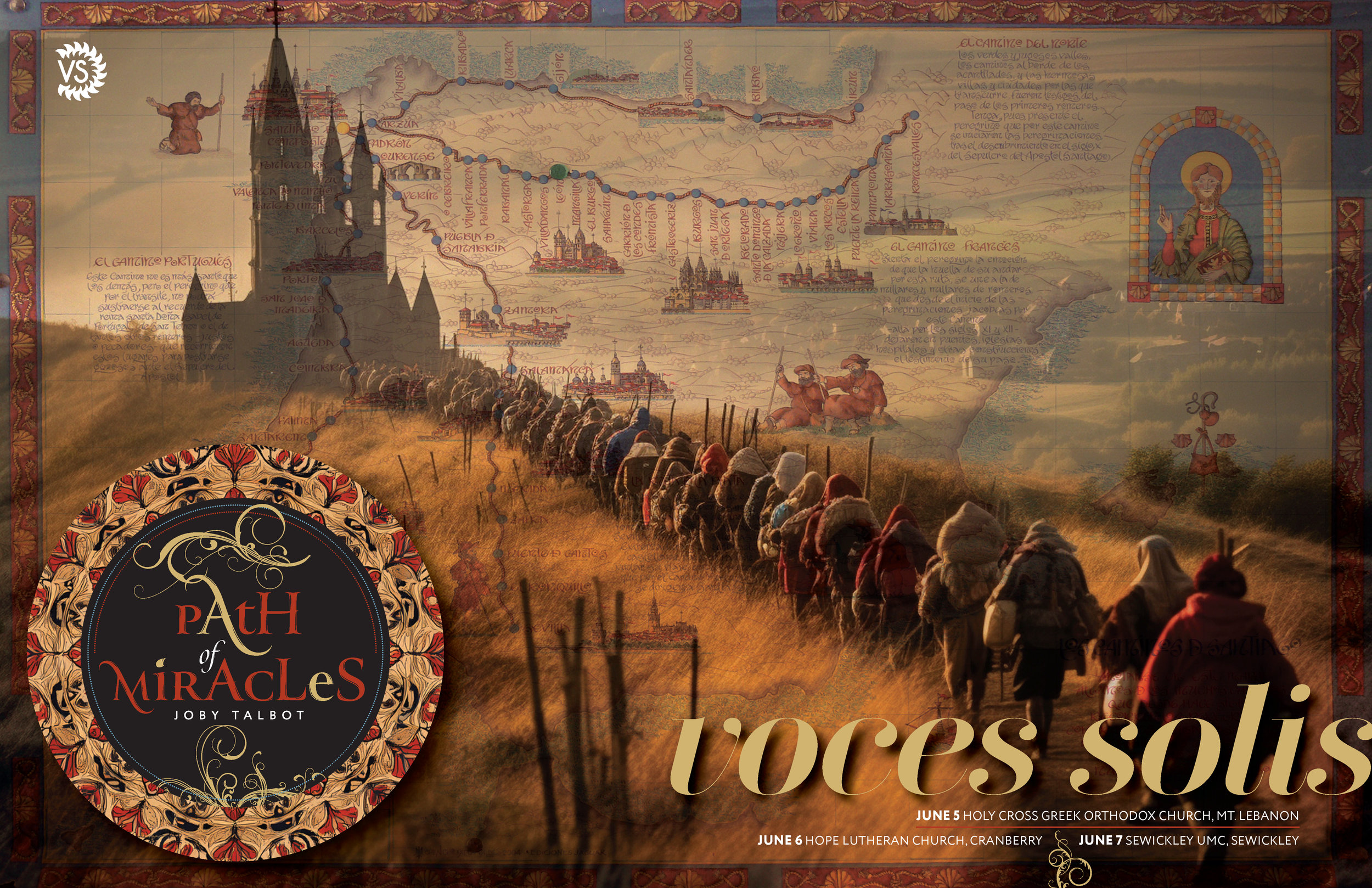
Path of Miracles
Joby Talbot
According to legend, after the death of Jesus, the Apostle James traveled to Spain to spread his teachings. Years later, after his return to Judea, James was executed by King Herod (Agrippa). After his death, his followers placed his body in a small unmanned boat made of stone. Guided by an angel, the boat carried him across the sea to Galicia in what is now northwestern Spain, where it came to rest at a burial ground.
In 814, a hermit, guided by the stars, discovered the place where St. James (Santiago) was buried. Soon after, that site became known as Santiago de Compostela — the final destination of the Camino pilgrimage. By the 12th century, Santiago de Compostela became the most visited shrine in the western world, and the Camino de Santiago (the Way of St. James) became one of the heaviest-traveled pilgrimage routes in the world.
In the early 2000s, British composer Joby Talbot visited many of the important landmarks along the Camino, including the four most important cathedrals in Roncesvalles, Burgos, Leon, and Santiago de Compostela.
Talbot draws on many musical styles in each movement, including Gregorian chant, medieval polyphony, Spanish and French Renaissance motets, Lutheran chorales, Romantic-era masterworks, Islamic chant (reflecting the Moorish influence in the Iberian peninsula), and even Arvo Pärt's tintinnabulation techniques.
Elements of the spiritual and nonspiritual are blurred, as sacred chants are merged with newly-composed music, and Biblical texts are combined with secular poetry. Much of the libretto in Path of Miracles comes from the Codex Calixtinus, a 12th century guidebook to the Camino.
Roncesvalles
Movement I
Eultreya! Esuseya!
Forward! Upward!
Using the Codex Calixtinus as its primary source, the libretto narrates the mysterious origins of the Camino and recounts the story of James, whose miraculous life and death serve as the motivation for thousands of pilgrims to walk the Camino.
In the opening movement, "Roncesvalles", Talbot captures the physical aspect of walking a pilgrimage through steady and unremitting rhythms, syncopation, and sudden pauses.
He sets each text chronologically beginning with James spreading the gospel in Greek, and continuing in Latin as educated students began to travel the route during the Middle Ages. Dialects of Spanish, Basque and old French follow, as people from the Iberian Peninsula and northern France undertook the pilgrimage. Later, as roads improved and travel advanced, pilgrims from German and English speaking countries were able to access the pilgrimage route.
Each of these languages is given its own motive, and the composer layers the motives into a complex polyphonic texture to recreate the sound of all these languages being heard simultaneously along the route today.
The combination of the latin-derived Ultreya “forward” and Suseya “upward” is a condition for success on the Camino de Santiago. As pilgrims advance along the path, they get closer and closer to Santiago de Compostela (“forward”); in turn, they feel more elevated in spirit, closer to the divine temple, and to the message following the example of the apostle (“upward"). It is a greeting and an encouragement on the path. To Ultreya, one must respond with Suseya.
Burgos
Movement II
The devil waits at the side of the road.
We trust in words and remnants, prayers and bones.
Danger and mischief characterize Talbot's impressions of the city of Burgos. Gabriel Crouch writes that "the insistent discords of the second movement reflect both the hardships of the road, keenly felt by this time after some initial euphoria in Roncesvalles, and the composer's own sense of discomfort on visiting Burgos."
The wild forests and ancient dwellings outside of Burgos are reported to be home to thieves, while the terrain is rocky and weather is often cold and rainy. These conditions exhaust the already-fatigued pilgrim. The long pauses in the music contrast with the steady unremitting rhythms of the first movement, and represent fatigue and the pilgrim's need for rest.
The setting and texts of "Burgos" portray the hardships of travel, as well as miracles that have occurred on the Camino. As the pilgrims undergo adversities together, celebrate joys, and witness the spiritual traditions of the Camino, a strong bond is created between them despite differences in language, social status, or culture.
León
Movement III
Li soleus qui en moi luist est mes dedu is, Et Dieus est mon conduis.
The sun that shines within me is my joy, and God is my guide.
This most pictorial and visual movement depicts the León Cathedral, known as the "House of Light." Scholar Georgiana King wrote that "standing in this church is like being in the heart of a jewel. It seems to have more stained glass than stone, less glass than light. How it must have awed pilgrims in the Middle Ages: could they have thought they'd already been granted a heavenly vision?"
Rest and refreshment characterize the musical impressions of this movement. Talbot represents the dazzling light radiating through the León cathedral with an ostinato motive in the soprano voices in the opening of the movement.
The repeated melodic sequence is exchanged between the soprano voices, leaving the impression that light is streaming through the stained glass with radiant colors and reflecting on surfaces throughout the cathedral.
Santiago
Movement IV
Herr Santiagu, Grot Santiagu!
Holy St. James, Great St. James!
Upon the pilgrims' arrival in Santiago, the choir sings an extended and ecstatic version of the ancient pilgrim's hymn: "Herr Santiagu, Grot Santiago!" transporting the listener back to the sound and experiences of the ancient pilgrims along the route.
Musically, this ancient hymn illustrates the pilgrims' feelings of connection with the human race through the shared traditions, hardships, and joys they experienced. The hymn is unique because its text is a mix of languages and dialects: Greek, Latin, Spanish, and Galician, reflecting the history and diversity of cultures of the Camino.
Interestingly, there is no definitive end or final release to Path of Miracles, but rather an ethereal disappearance of sound and text. This represents the final stop of the pilgrimage, Finesterre – “the end of the earth" – as the pilgrims' final prayer to St. James dissipates out to sea.
On reaching Santiago itself, I bent down to kiss the head of the little statue of St. James that sits at the base of the central column of the cathedral's west front.
As I steadied myself against the pillar, I felt my fingers slip into an inch-deep handprint in the solid granite, formed there by generation after generation of pilgrims, doing exactly what I was doing, for more than nine hundred years.
The connection to the past seemed palpable, and it was the feeling I experienced at that moment that I resolved to try to express in the music.
-Joby Talbot
Text and Translations
Roncesvalles
Movement I
Greek
Κατ εκεινον δε τον καιρον
επεβαλεν ηρωδηζ ο βασιλευζ
ταζ χειραζ κακωσαι τιναζ των
απο τηζ εκκλησιαζ.
Ανειλεν δε ιακωβον τον αδελφον
ιωαννου μαχαιρα.
English
Now about that time Herod the king stretched forth his hands to vex certain of the
church. And he killed James, the brother of John, with the sword.
Latin
Eodem autore tempore misit Herodes rex manus ut adfligeret quosdam de ecclesia
occidit autem Iacobum fratrem Iohannis gladio.
Spanish
En aquel mismo tiempo el rey Herodes echó mano a algunos de la iglesia para
maltratarles. Y mató a espada a Jacobo, hermano de Juan.
Galician
Aldi hartan, Herodes erregea eliz elkarteko batzuei gogor erasotzen hasi zen. Santiago,
Joanen anaia, ezpataz hilarazi zuen.
French
Ver ce temps-là, le roi Hérode se mit à persécuter quelques-un de membres de l’Église. Il
fit mourir par l’épée Jacques, frère de Jean.
German
Um dieselbige Zeit legte der König Herodes die Hände an, etliche von der Gemeinde, sie
zu peinigen. Er tötete aber Jakobus, den Bruder des Johannes, mit dem Schwert.
Before this death the Apostle journeyed,
preaching the word to unbelievers.
Returning, unheeded, to die in Jerusalem
a truth, a truth beyond Gospel.
Jacobus, filius Zebedaei, frate Johannis,
Hic Spaniae et occidentalia loca praedicat.
Foy el o primeiro que preegou en Galizia.
James, son of Zebedee, brother of John,
at that time was to preach in Spain and the Western places
He was the first to preach in Galicia.
Huius beatissimi apostoli sacra ossa ad Hispanias translata.
Et despois que o rrey Erodes mãdou matar en Iherusalem,
trouxerõ o corpo del os diçipolos por mar a Galiza.
The sacred bones of the blessed apostle taken to Spain.
After King Herod killed him in Jerusalem,
his disciples took the body by sea to Galicia.
Holy Saint James
Great Saint James
God help us now
And evermore.
Herr Santiagu
Grot Sanctiagu
Eultreya esuseya
Deius aia nos.
Herod rots on a borrowed throne
while the saint is translated to Heaven and Spain
the body taken at night from the tomb
the stone of the tomb becoming the boat
that carries him back
ad extremis terrarium to the ends of the earth
back to the land that denied him in life.
From Jerusalem to Finisterre,
from the heart of the world to the end of the land.
In a boat made of stone, without rudder or sail.
Guided by grace to the shore of Galicia
Herr Santiagu, Grot Sanctiagu,
Eultreya esuseya, Deius aia nos.
O ajutor omnium seculorum,
O decus apostollorum,
O lus clara galicianorum,
O avocate peregrinorum,
Jacobe, suplantatur viciorum
Solve nostrum Cathenes delitorum
E duc a salutum portum.
Holy Saint James, Great Saint James
God help us now and evermore.
O judge of all the world
O glory of the apostles
O clear light of Galicia
O defender of the pilgrims
James, destroyer of sins
Deliver us from evil
And lead us to safe harbor
Abandoning to Providence
the care of the tomb.
Abandonnant à la Providence
la soin de la sepulture.
At night on Lebredon by Iria Flavia
the hermit Pelayo at prayer and alone
Saw in the heavens a ring of bright stars
shining like beacons over the plain
And as in Bethlehem the Magi were guided
the hermit was led by this holy sign
For this was the time given to Spain
for St. James to be found after eight hundred years
in Compostella, by the field of stars.
Holy Saint James
Great Saint James
God help us now
And evermore.
Herr Santiagu
Grot Sanctiagu
Eultreya esuseya
Deius aia nos.
Burgos
Movement II
Innkeepers cheat us, the English steal,
The devil waits at the side of the road.
We trust in words and remnants, prayers and bones.
We know that the world is a lesson
As the carved apostles in the Puerta Alta
Dividing the damned and the saved are a lesson.
We beat our hands against the walls of heaven.
St Julian of Cuenca,
Santa Casilda, pray for us.
Remember the pilgrim robbed in Pamplona,
Cheated of silver the night his wife died;
Remember the son of the German pilgrim
Hanged as a thief at the gates of the town,
Hanged at the word of an innkeeper’s daughter.
Innkeepers cheat us, the English steal,
The devil waits at the side of the road.
We trust in words and remnants,
prayers and bones.
Santiago Peregrino: Saint James the Pilgrim
His arm is in England, his jaw in Italy,
And yet he works wonders.
The widower, the boy on the gallows
He did not fail them.
One given a horse on the road by a stranger,
One kept alive for twenty-six days,
Unhurt on the gallows for twenty-six days.
His jaw is in Italy, yet he speaks.
The widower robbed in Pamplona:
Told by the Saint how the thief
Fell from the roof of a house to his death.
His arm is in England, yet the boy,
The pilgrim’s son they hanged in Toulouse
Was borne on the gallows for twenty-six days
And called to his father: Do not mourn,
For all this time the Saint has been with me.
O beate Jacobe. O blessed Saint James
Innkeepers cheat us, the English steal.
We are sick of body, worthy of hell.
The apostles in the Puerta Alta
Have seen a thousand wonders;
The stone floor is worn with tears,
With ecstasies and lamentations.
We beat our hands against the walls of heaven.
Santiago Peregrino: Saint James the Pilgrim
The devil waits in a turn in the wind
In a closing door in an empty room.
A voice at night, a waking dream.
Traveler, be wary of strangers,
Sometimes the Saint takes the form of a pilgrim,
Sometimes the devil the form of a saint.
Pray to the Saints and the Virgen del Camino,
To save you as she saved the man from Lyon
Who was tricked on the road by the deceiver,
Tricked by the devil in the form of St James
And who killed himself from fear of hell;
The devil cried out and claimed his soul.
Weeping, his companions prayed.
Saint and Virgin heard the prayer
And turned his wound into a scar,
From mercy they gave the dead man life.
Innkeepers cheat us, the English steal,
We are sick of body, worthy of hell.
We beat our hands against the walls of heaven
and are not heard.
We pray for miracles and are given stories;
Bread, and are given stones.
We write our sins on parchment
To cast upon his shrine in hope they will burn.
We pray to St Julian of Cuenca,
to St Amaro the Pilgrim,
to Santa Casilda,
to San Millan and the Virgin of the Road.
We pray to Santiago.
We know that the world is a lesson
As the carved apostles in the Puerta Alta
Dividing the damned and the saved are a lesson.
We pray the watching saints will help us learn.
Ora pro nobis, Jacobe,
Pray for us, Saint James
A finibus terrae ad te clamavi
From the end of the earth I cry to you
León
Movement III
The sun that shines within me is my joy,
And God is my guide
Li soleus qui en moi luist est mes deduis,
Et Dieus est mon conduis.
We have walked in Jakobsland:
Over river and sheep track,
by hospice and hermit’s cave.
We sleep on the earth and dream of the road,
We wake to the road and we walk.
Wind from the hills, dry as the road,
Sun overhead, too bright for the eye.
Rumours of grace on the road, of wonders:
The miracles of Villasirga,
The Virgin in the apple tree.
The Apostle on horseback
a journey of days in one night.
God knows we have walked in Jakobsland:
Through the Gothic Fields,
from Castrogeriz to Calzadilla,
Calzadilla to Sahagun,
each day the same road, the same sun.
How lovely is your dwelling place
O Lord of Hosts
Quam dilecta tabernacula tua,
Dominum virtutem
Here is a miracle.
That we are here is a miracle.
Here daylight gives an image of
The heaven promised by His love.
Beate, qui habitant in domo tua,
Domine,
In saecula saeculorum laudabant te.
Blessed are they that dwell in your house,
Lord,
They will always be praising you.
We pause, as at the heart of a sun
That dazzles and does not burn.
Li soleus qui en moi luist est mes deduis,
Et Dieus est mon conduis.
The sun that shines within me is my joy,
And God is my guide
Santiago
Movement IV
The road climbs through changing land.
Northern rains fall on the deepening green
of the slopes of the valley,
Storms break the summer’s heat;
At Foncebadon a pass can be lost,
in one night, to the snow.
The road climbs for days through the highlands of Bierzo,
To the grassland and rocks of the Valcarce valley.
White broom and scrub-oak, laburnum and gorse
Mark the bare hills beside the road.
At O Cebreiro, mountains.
The road follows the ridgetop
By meadows of fern, by fields of rye.
By Fonfria del Camino, by Triacastela.
Towns are shadows the road leaves behind.
It moves over the slate hills.
Palas do Rei. Potomarin.
The names are shadows.
Then, from the stream at Lavacolla
To the foot of Monte de Gozo, a morning;
From the foot of Monte de Gozo
To the summit of Monte de Gozo
The road climbs, before the longed-for final descent
To Santiago.
Herr Santiagu
Grot Sanctiagu
Eultreya esuseya
Deius aia nos.
Holy Saint James
Great Saint James
God help us now
And evermore.
O beate Jacobe, virtus nostra vere,
O blessed James, truly our strength,
Patri tam eximio dignes laudes demus
rightfully owe to so excellent a father.
Herr Santiagu
Grot Sanctiagu
Eultreya esuseya
Deius aia nos.
Holy Saint James
Great Saint James
God help us now
And evermore.
At the Western edge of the world
We pray for our sins to fall from us
As chains from the limbs of penitents.
We have walked out of the lives we had
And will return to nothing, if we live,
Changed by the journey, face and soul alike.
We have walked out of our lives
To come to where the walls of heaven
Are thin as a curtain, transparent as glass.
Where the Apostle spoke the holy words,
Where in death he returned, where God is close,
Where saints and martyrs mark the road.
Santiago, primus ex apostolis the first of the apostles
Defender of pilgrims, warrior for truth,
Take from our backs the burdens of life.
What we have done, who we have been;
Take them as fire takes the cloth
They cast into the sea at Finisterre.
Holy St. James, great St. James,
God help us now and evermore.
Longed-for spring returns, with joy,
adorned with shining flowers. The birds
sing so sweetly, the woods burst into leaf,
there is pleasant song on every side.
Ver redit optatum, cum gaudio,
Flore decoratum purpureo;
Aves edunt cantus quam dulciter,
Cantus est amoenus totaliter
The whole world gives thanks to James;
through his sacrifice, he, the warrior of
godliness, is a great defense to all through
their prayers.
Jacobo dat parium omnis mundus gratis
Ob cuius remedium miles pietatis
Cunctorum presidium est
ad vota satis.
take our enemies from us and protect your people,
Nobis hostes remove tuos ac tuere
and cause us, your faithful servants, to please you.
Ac devotos adibe nos tibi placer.
James, let us hope for pardon through your favor
Jacobo, propicio veniam speramus,
and let us give the worthy praise, which we
Et quas ex obsequio merito debemus,